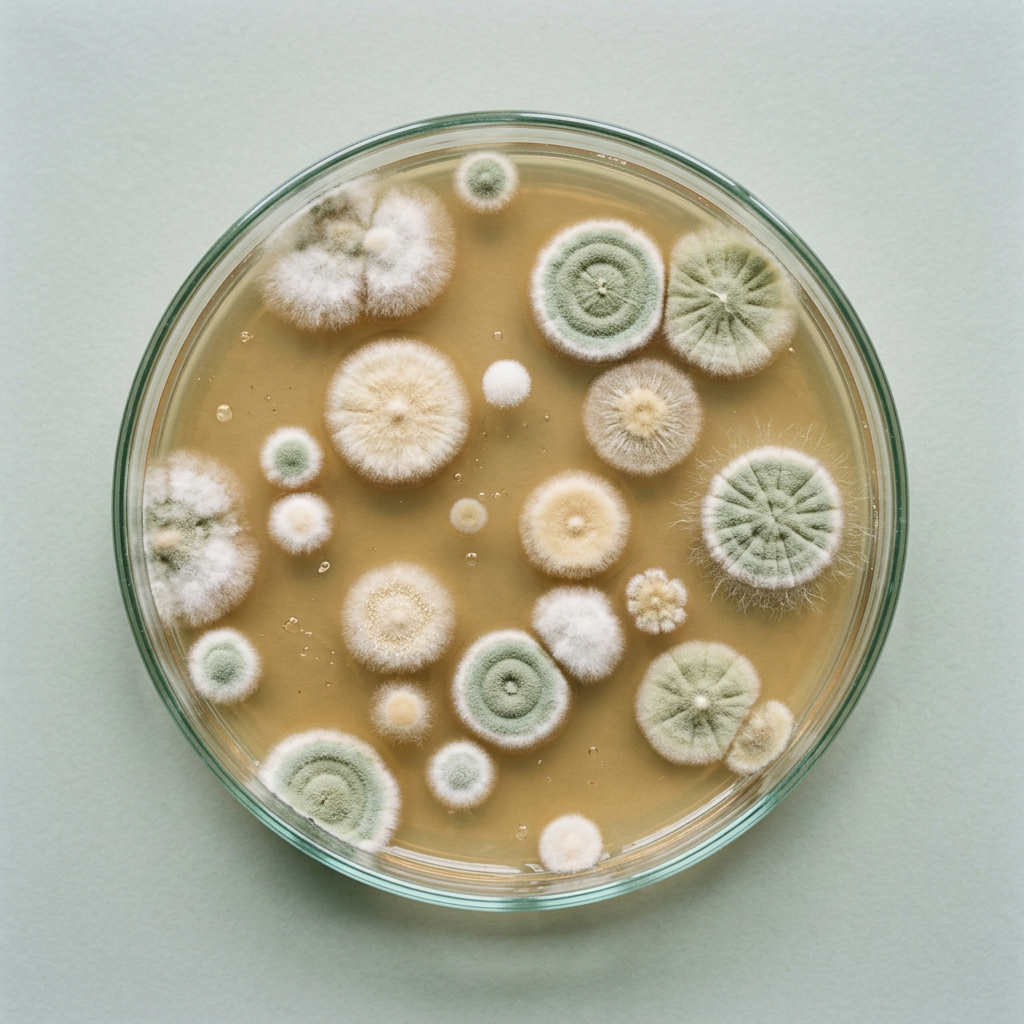
Half of the public sequence data on WHO's priority fungi is one species.
- Total records
- 68,780
- Assembled genomes
- 5,181
- SRA WGS runs
- 63,599
- Species groups
- 19
- Countries
- 126
A handful of species dominate the data.
Candida auris accounts for 50.0% of the 68,780 assembly and SRA run records shown here, much of it deposited by public health laboratories. At the other end, Pneumocystis jirovecii has 12 records in total.
Critical
4 species74.8%
2,093 genomes
49,331 SRA runsHigh
7 species22.1%
2,919 genomes
12,256 SRA runsMedium
8 species3.2%
169 genomes
2,012 SRA runs
Widely different reported metadata
Combined genomes and SRA runs per species, with the share of records that carry a location and a collection date. Mucorales and Pichia kudriavzevii have both for only about a quarter of their records.
- Candida auris34,410Place92%Date94%
- Cryptococcus neoformans6,862Place58%Date47%
- Fusarium spp.6,258Place87%Date76%
- Aspergillus fumigatus5,320Place53%Date47%
- Candida albicans4,832Place66%Date65%
- Mucorales2,430Place32%Date25%
- Nakaseomyces glabrata2,251Place87%Date86%
- Candida parapsilosis1,963Place84%Date50%
- Candida tropicalis1,581Place89%Date89%
- Pichia kudriavzevii791Place36%Date27%
- Histoplasma spp.595Place91%Date83%
- Coccidioides spp.428Place86%Date73%
- Cryptococcus gattii397Place80%Date37%
- Talaromyces marneffei383Place99%Date95%
- Paracoccidioides spp.112Place96%Date36%
- Eumycetoma agents97Place92%Date95%
- Scedosporium spp.38Place84%Date66%
- Lomentospora prolificans20Place100%Date85%
- Pneumocystis jirovecii12Place67%Date33%
Geography
Where isolates were sampled
Country of origin parsed from the location field, shaded on a log scale so a few heavily sampled countries do not hide the rest.
Hover a country
Timeline
Genomes over time
Assemblies and sequencing runs by the year the sample was collected, or by the year the record was released.
373 records collected before 1990 are not shown.
- Critical
- High
- Medium
Where the isolates come from
Derived from BioSample host, isolation source and host disease fields.
Candida auris
Almost entirely a hospital organism
32,123 of 34,410 records list Homo sapiens as host, mostly urine, blood and axilla/groin swabs, with 561 wastewater samples.
Fusarium spp.
Sampled from fields, not patients
Top hosts are chickpea (591), rice (339) and wheat (230). Only 167 records come from humans.
Cryptococcus neoformans
Lab strains blur the picture
Frequently reported isolation sources include laboratory crosses, frozen stocks, experimental samples and cerebrospinal fluid from patients.
Eumycetoma agents
Small, but complete
Of 97 records, 87 report a human host and 92 report a collection date.
Who is depositing
The leading submitting centre for a few species, genomes and SRA runs combined.
- Candida auris5,439
UPHL_ID
Public health laboratories dominate, followed by NVSPHL (4,730) and MDH_CSL (2,629).
- Cryptococcus neoformans1,298
Broad Institute
Research institutes lead, with Duke University (891) close behind.
- Candida albicans772
Institut Pasteur
A spread of universities and hospitals, no single dominant depositor.
- Mucorales1,361
JGI
One genome-sequencing centre accounts for over half of all records.
Methods
Built from NCBI with automatic updates
A short description of the pipeline and the caveats worth knowing before you cite a number from this page.
Species selection
The 19 entities on the WHO Fungal Priority Pathogens List (2022) are queried. Where NCBI taxonomy has been renamed, such as Candida glabrata to Nakaseomyces glabrata, both names are searched and results deduplicated by accession.
Assembled genomes
Assembly metadata comes from the NCBI Datasets CLI, including GenBank and RefSeq. We extract accession, taxonomy, release date, assembly level, submitter and BioSample attributes.
SRA WGS runs
Read metadata is pulled through E-utilities and filtered to library_source GENOMIC and library_strategy WGS. Placeholders such as "missing" or "not collected" are treated as absent.
Host categorisation
Host, isolation source and host disease are matched against keyword lists to assign human, animal, plant, environment, food, clinical other or unknown. Raw NCBI strings are always kept.
Read before you cite
- SRA counts for genus-level queries may include non-pathogenic species in the genus.
- Geographic parsing is approximate. Sub-national locations without a country prefix can be missed.
- Collection dates vary in precision, and only the year is used in temporal charts.
- Host categories rely on keyword matching against free text, so ambiguous records land in unknown.
- Submitter names are not curated; one organisation can appear under several aliases.
- Some NCBI assemblies are suppressed or superseded but still returned by the Datasets CLI.
Download the underlying tables
genomes.csv
5,181 rows · 1.5 MB
One row per assembled genome with NCBI accession, assembly level, host, isolation source, location, collection date and derived host category.
Download CSVsra_runs.csv
63,599 rows · 13.5 MB
One row per SRA whole-genome sequencing run with platform, strategy, host, location, date, submitter and derived categories.
Download CSVhost_categories.csv
19 rows · 1.1 KB
Records per species grouped into host categories, with WHO priority tier.
Download CSVsubmitter_categories.csv
19 rows · 1.1 KB
Records per species grouped by type of submitting institution.
Download CSVsubmitters.csv
178 rows · 10 KB
The top ten submitting institutions for each species group.
Download CSV